


McDonnell Douglas F-4 Gun Nosed Phantoms - Warbird Tech Vol 8
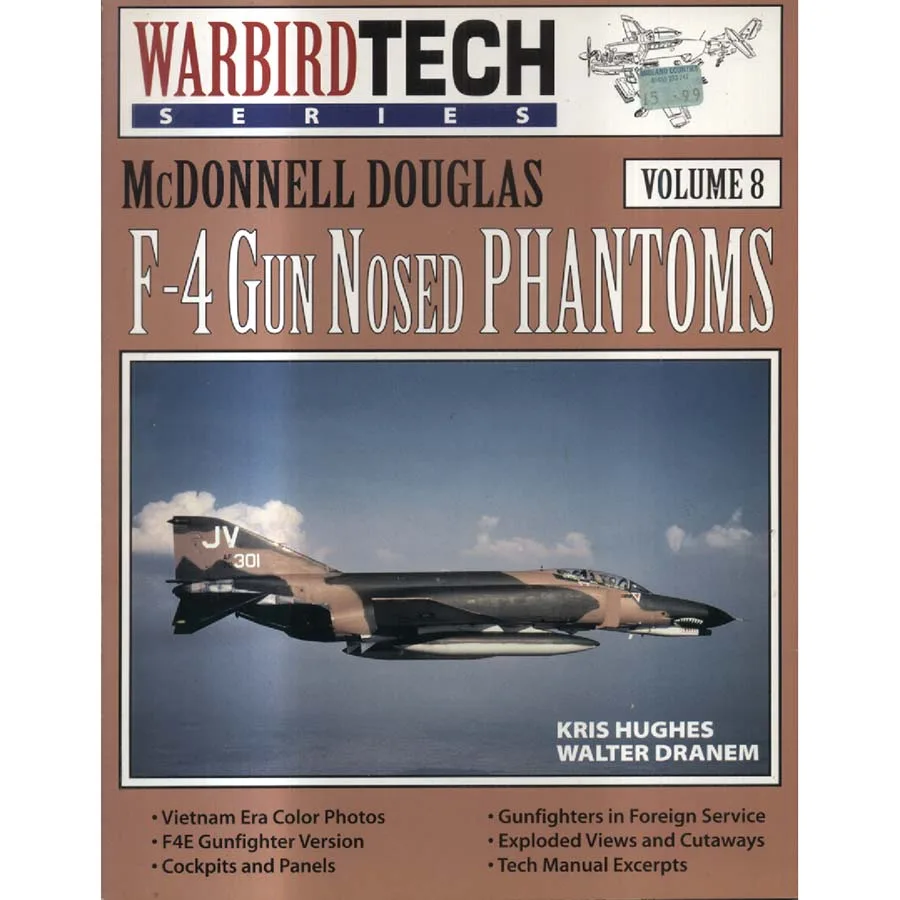
Publisher: Specialty Press
Format: Paperback
ISBN: 093342471X
The McDonnell Douglas F-4 Phantom II was designed during an optimistic period when military planners believed the guided missile had made the aircraft cannon obsolete. Future aerial combat would be conducted at a dignified distance by sophisticated electronics, and no pilot would again need to manoeuvre behind an opponent and shoot at it. The Vietnam War then supplied the customary field test of an immaculate theory.
McDonnell Douglas F-4 Gun-Nosed Phantoms examines the development of the later Phantom variants fitted with an internal cannon, most notably the F-4E. Beneath its extended nose sat the six-barrel M61 Vulcan, capable of firing several thousand rounds per minute and restoring to the aircraft an ability its designers had confidently declared unnecessary. Technological progress occasionally involves installing the thing removed during the previous round of technological progress.
Kris Hughes and Walter Dranem trace the Phantom from its early production and adoption by the United States Air Force through the combat experience that produced the gunfighter version. The original F-4 had speed, power, radar, missiles and a crew of two, but close-range engagements exposed the disadvantages of relying entirely upon weapons that did not always lock on, launch or hit the intended aircraft. A cannon remained refreshingly uncomplicated once everybody had completed the difficult business of pointing the aeroplane.
The book looks beneath the Phantom’s famously substantial exterior through technical-manual extracts, cutaway and exploded views, diagrams and detailed photographs. Airframe construction, cockpit equipment, engines, weapons and systems are presented for the enthusiast who wants more than a handsome photograph disappearing into cloud. The Phantom contained an enormous quantity of machinery, much of it apparently fitted wherever engineers discovered an unoccupied cavity.
Operational photographs show the gun-nosed aircraft in service, particularly over Vietnam, where its size, twin engines and characteristic smoke trails made it difficult to mistake for anything subtle. The Phantom was fast, rugged and immensely capable, but concealment was not among its leading qualities. It entered combat rather as a large industrial building might arrive if provided with afterburners.
The volume also follows subsequent versions and developments as the basic airframe was adapted for different roles and operators. The Phantom became fighter, interceptor, strike aircraft, reconnaissance platform and radar-suppression specialist, enjoying the sort of career flexibility now demanded on application forms but seldom achieved by the applicants.
This is Volume 8 in the Warbird Tech series, intended to combine accessible aviation history with enough engineering detail to satisfy modellers, restorers and readers who regard a cockpit photograph as incomplete unless every switch can be identified. It is especially useful as a visual reference, with its mixture of vintage imagery and technical material showing not merely what the aircraft looked like but how its various alarming components fitted together.
Published by Specialty Press in 1997, this is a compact but information-rich study of one of the defining combat aircraft of the Cold War. It will appeal to Phantom enthusiasts, military aviation historians, scale modellers and anyone interested in the lengthy process by which an aircraft originally denied a gun became celebrated as a gunfighter.
This copy is in Very Good condition. It has survived nearly three decades with little wear and remains clean, sound and ready for inspection. No cannon residue, hydraulic fluid or characteristic J79 smoke has been detected on the pages.
Sold by Crappy Old Books, where all Phantoms are supplied without fuel, ammunition or permission to make a low-level pass over the dispatch department.
Keep browsing: See more War books Other books by Kris Hughes - Walter Dranem
